By Michelle Kurosawa, Founder & CEO, Additiveio —
The AS9100D standard does not specify how long qualification should take. It specifies what must be documented, controlled, and demonstrated. The 6-to-18-month timelines that aerospace procurement teams have come to accept as normal are not a requirement of the standard — they are an artifact of how the qualification process has historically been organized relative to the manufacturing process.
In casting-based supply chains, documentation and manufacturing happen on separate tracks that only converge at delivery. The toolmaker produces a die; months later, a casting supplier pours the first article; months after that, a quality engineer assembles the documentation package from records that were generated independently by each sub-process. The qualification clock doesn't start until the part exists, and it doesn't stop until every document has been collected, reviewed, and approved through a chain of organizations that were never tightly coordinated to begin with.
LPBF changes the manufacturing physics. The document architecture doesn't have to follow the old model.
What AS9100D actually requires
At its core, AS9100D requires that an organization demonstrate: control of processes affecting product conformity (Clause 8.5), traceability of product and process data (Clause 8.5.2), control of customer-supplied property including data (Clause 8.5.3), documented evidence of conformity to requirements (Clause 8.6), and control of nonconforming outputs (Clause 8.7). It also requires that the organization plan and implement processes for first article inspection where applicable.
None of these clauses require that documentation be assembled after the fact. In fact, the intent of Clause 8.5.1 — control of production and service provision — is that plans and process parameters are established before production begins. AS9100D is asking for a controlled process. A controlled process generates records in real time, not retrospectively.
The 18-month qualification timeline in casting supply chains is not an AS9100 requirement. It is a consequence of treating documentation as a post-process deliverable rather than a build-concurrent output.
The problem with retrospective documentation
When documentation is assembled after the part exists, several failure modes become common.
Record gaps. A subcontractor who performed the solution anneal six months ago may not have retained the furnace chart in a format compatible with the prime's documentation requirements. Obtaining a compliant copy, or re-performing a heat treatment cycle to generate a new record, can add weeks to the qualification timeline.
Conflicting revision levels. The drawing may have been revised between the tooling order and the first article pour. If the casting was made to an earlier revision, the dimensional inspection report references feature numbers that no longer match the current drawing. Every discrepancy requires a nonconformance review and disposition before qualification can close.
Powder or material ambiguity. In a multi-step process chain with sub-tier suppliers, tracing the exact material heat number from the final inspection record back to the original mill certificate can require four or five separate record requests. Any break in that chain is a nonconformance.
These are not exotic failure modes. They are routine complications that experienced aerospace procurement managers have encountered dozens of times. The 18-month quote is partly a genuine process duration and partly a buffer that experienced suppliers build in to accommodate the documentation cleanup that they know will follow every first article.
How LPBF changes the architecture
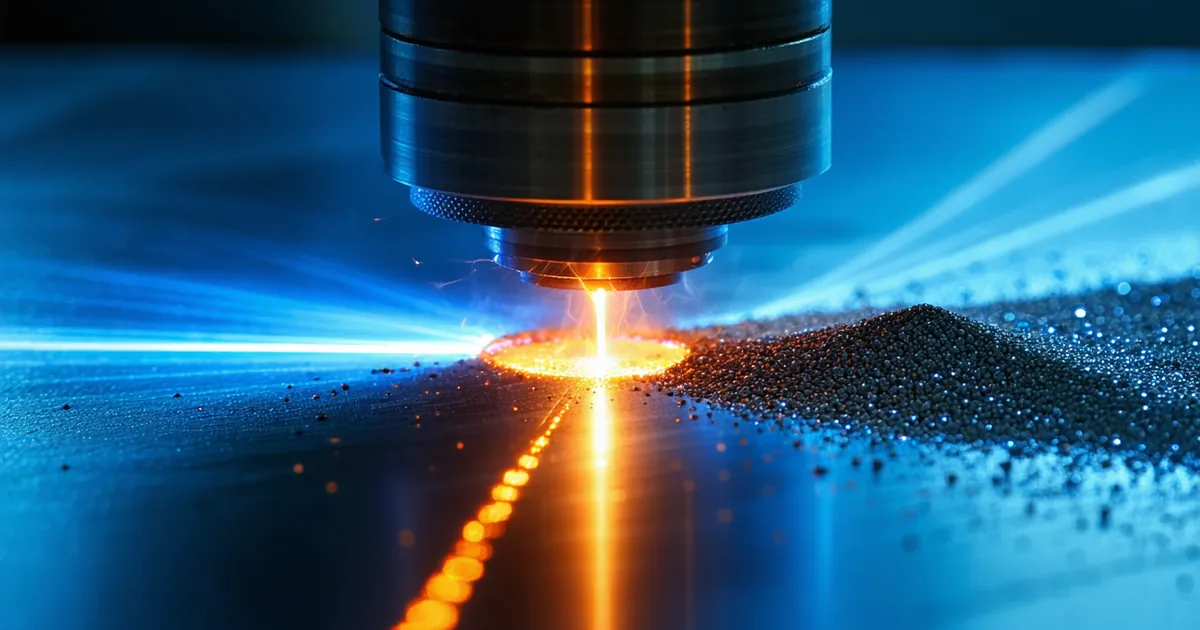
Laser powder bed fusion is a fully digital process from start to finish. The machine executes a build file; the build file is a controlled document. Every parameter — layer thickness, laser power, scan speed, hatch spacing, oxygen concentration — is recorded in the machine's build log for every layer of every part. That log is not something an engineer assembles after the fact. It is generated automatically, tied to the part serial number at the point of build, and archived without additional effort.
At Additiveio, we designed our documentation system to treat the build log as the primary quality record from which everything else chains. Powder incoming inspection records are linked to the powder lot ID before the build begins. The build log references that powder lot ID. The HIP cycle record references the build job number. The CMM dimensional report and NDT results reference the part serial number that was assigned before the first layer was melted. When the part ships, the documentation package is a connected chain of records that were generated concurrently with the manufacturing steps, not assembled afterward.
The practical consequence: our qualification cycle for a first article runs approximately six weeks from DfAM review sign-off to documentation package delivery. That six weeks includes the build, the post-build HIP cycle (typically 3–4 hours at 900°C and 100 MPa argon pressure), stress relief anneal, wire EDM separation from the build plate, CNC finish machining where required, CMM inspection, micro-CT scanning, and documentation review.
What "AS9100-ready" means and doesn't mean
Additiveio is an early-stage company founded in 2024. We do not claim AS9100 certification — that claim requires a third-party audit and certification body issuance, and we are transparent that we have not yet pursued that audit. "AS9100-ready" means that our process was designed to satisfy AS9100D requirements from the beginning: our build records, material traceability chain, inspection workflow, and documentation package format are all structured to align with AS9100D clause requirements. When an aerospace customer brings their quality engineer to review our process, the documentation architecture they see is recognizable as AS9100-compatible.
This distinction matters. A supplier that claims AS9100 certification without the audit is fabricating a credential. A supplier that describes their process as AS9100-ready and explains exactly what that means is giving a procurement manager the information they need to make an honest assessment. Aerospace quality engineers are trained to evaluate process documentation; they do not need a certificate number if the process records are sound.
The single-cycle approach in practice
When a program starts with Additiveio, the documentation architecture begins at the same time as the engineering review. Before we write a build plan, we establish the traceability record structure: part serial number assignment convention, powder lot record template, build log archival path, and inspection report format. When the engineer submits the final DfAM review sign-off, the documentation shell is already populated with everything except the build-specific records that will be generated during manufacturing.
During the build, the machine generates layer-resolved build data automatically. Our process engineer reviews that data for anomalies at defined intervals — not after the build completes, but during it. If an anomaly is detected (a melt pool irregularity, a transient oxygen spike above the 50 ppm threshold, a layer adhesion indicator outside the control band), a build hold is issued and an engineering review determines the disposition before the build continues. This means the NDT and dimensional inspection that follows the build is confirmation of an already-controlled process, not investigation of an unknown.
The result is a documentation package that is substantially complete before the part leaves our facility for inspection. There is no documentation collection phase after delivery, no follow-up requests to subcontractors, and no revision-level reconciliation because the build was executed to a single controlled drawing revision with a documented change control record if any revision occurred during the program.
Where the six weeks go
For reference, the six-week engagement breaks down approximately as follows:
- Week 1: DfAM review and feedback (48-hour initial response; revision cycle if needed); parameter lock and build plan sign-off; documentation architecture setup.
- Week 2: Build execution. A typical bracket geometry at 30 µm layer thickness on a 255 × 255 × 300 mm build volume runs 18–36 hours of laser time depending on part count and geometry complexity.
- Weeks 2–3: Post-build processing. Stress relief anneal (per AMS 2801); HIP cycle (typically 3 hours dwell at temperature); wire EDM or band saw separation from build plate; CNC finish machining of critical datum surfaces or mating features.
- Week 4: Inspection. Dye penetrant; micro-CT scan; CMM dimensional report to drawing. Defect disposition if applicable.
- Weeks 5–6: Documentation review, package compilation, and customer delivery. Any nonconformances are dispositioned and closed within this window.
Each step generates records that feed into the documentation package as they are completed. By the time the part ships, the package is assembled.
The broader implication for aerospace AM qualification
The metal additive manufacturing industry has spent the last decade earning aerospace customers' trust by demonstrating that LPBF parts can meet AS9100 mechanical requirements. The next phase of that maturation is demonstrating that the documentation process can be as well-controlled as the metallurgical process. Qualification timelines in the 12-to-18-month range are not inherent to the standard. They are a process design choice — and they can be designed differently.
If you are evaluating a titanium LPBF supplier for a qualification program and the quoted lead time is twelve months or more, the first question to ask is: how much of that time is manufacturing, and how much is documentation collection? If the answer is "we don't really separate those," that is useful information about how the process is structured.
Additiveio's process is built on the assumption that every week spent on retrospective documentation is a week that didn't have to happen. We are not the first shop to think this way, and we will not be the last — but it is how we designed this operation from the beginning.