How we print flight-qualified titanium
From CAD review to documentation delivery in a single six-week engagement. Every step is instrumented, every record tied to your part serial number.
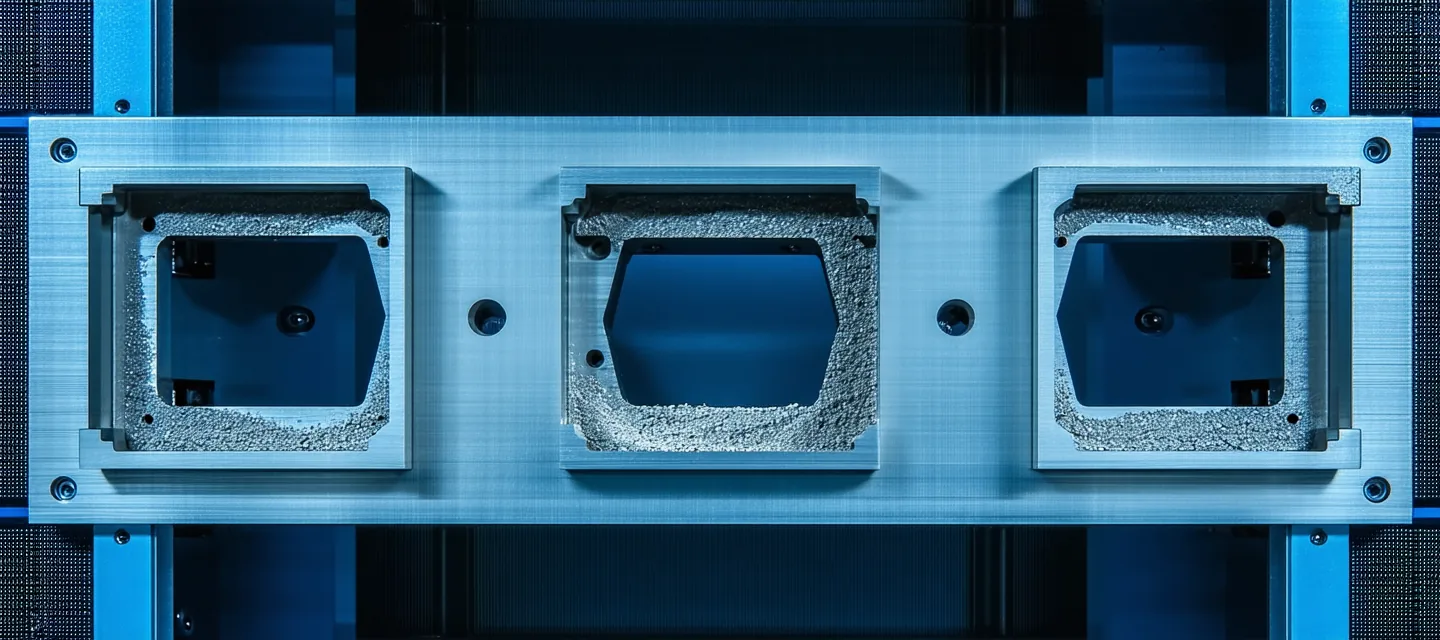
Laser Powder Bed Fusion — four phases
LPBF builds parts layer by layer from spherical titanium powder. We manage each phase to produce flight-grade density and microstructure.
Powder Preparation
Ti-6Al-4V ELI powder sourced from qualified vendors per AMS 4928. Incoming inspection covers particle size distribution (D10/D50/D90), chemistry, and flowability. Each lot is assigned a material heat number tied to the build record.
Layer-by-Layer Fusion
A high-power fiber laser traces the cross-section of each layer at 20–40 µm thickness. Scan strategy — hatching angle, island rotation, overlap — is fixed per part geometry. Inert argon atmosphere is maintained below 50 ppm O₂ throughout.
In-Process Monitoring
Melt pool imaging and layer-resolved build logs are captured for every build. Any anomaly triggers a hold and engineering review before the build continues. Oxygen concentration, temperature, and chamber pressure are logged in real time.
Post-Build HIP & Heat Treatment
Hot Isostatic Pressing (HIP) closes residual porosity and improves fatigue life. A stress relief cycle is applied before HIP. Heat treatment parameters are per AMS 2801 and documented in the certification package delivered with the part.
Representative Ti-6Al-4V LPBF build parameters
These ranges are representative of standard Ti-6Al-4V LPBF practice. Actual parameters are locked per geometry and are proprietary to each build plan.
Qualification in a single build cycle
All five qualification milestones happen within one six-week engagement. No tooling lead time, no second-build qualification cycle, no retrospective documentation assembly — because the records are generated in parallel with the part.
Ready to qualify your first bracket?
Submit your CAD and part requirements. We respond with a detailed quote within 48 business hours.