By Michelle Kurosawa, Founder & CEO, Additiveio —
When an aerospace procurement manager asks for powder traceability records on a titanium LPBF part, they are asking a specific question: can you prove that the powder used in this build came from a qualified source, met the chemistry and particle size requirements, and was handled in a way that didn't introduce contamination before it entered the machine? The certificate of conformance from the powder vendor is one input into that answer. It is not the complete answer.
This article describes what a complete traceability chain looks like for Ti-6Al-4V ELI powder in an aerospace LPBF operation, where the chain can break, and what records are needed at each node to satisfy an AS9100D-compatible audit trail.
What AS9100D says about material traceability
AS9100D Clause 8.5.2 requires that the organization use suitable means to identify outputs when it is necessary to ensure the conformity of products and services, and maintain documented information describing the identification of output and traceability where required. For aerospace flight hardware, traceability is almost always required — either by customer flow-down requirements, or by the organization's own control plan.
For powder-bed-fusion processes, the material output (a printed part) is directly dependent on the input material (the powder) in a way that is more tightly coupled than in most subtractive processes. A machined part made from a billet can be traced to a mill cert through the raw stock serial number stamped on the billet. A printed part is made from powder that was loaded into a reservoir, partially consumed during the build, and the remainder returned to stock — or blended with fresh powder for the next build. The traceability challenge is different in kind, not just in degree.
Node 1: Vendor qualification and lot-level certification
The traceability chain begins before powder enters your facility. The first question is whether the vendor is qualified — meaning you have evaluated their quality system, their atomization process, and their ability to produce consistent powder to your specification. For aerospace Ti-6Al-4V ELI, the relevant specification is AMS 4928 for chemical composition, supplemented by your own or customer-specified requirements for particle size distribution (PSD) and flowability.
A qualified powder vendor delivers each order with a lot-specific certificate of conformance that reports: chemical composition per AMS 4928 limits (Al, V, O, N, C, H, Fe, and trace elements), particle size distribution (D10, D50, D90 by laser diffraction), and flowability (Hall flow rate per ASTM B213). These are not optional items — they are the minimum data set required to accept a powder lot for use in flight-hardware builds.
The vendor's lot number is the anchor for your chain. Every subsequent record references this lot number. If you do not record the vendor's lot number at the point of receipt, the chain is broken at the first link.
Node 2: Incoming inspection at your facility
Relying solely on the vendor's CoC is not sufficient for flight hardware. The incoming inspection at your facility is an independent verification that the lot received matches the lot certified. This does not require duplicating the vendor's full analytical suite — but it does require targeted spot checks that would detect the most likely failure modes: lot mix-up, contamination during shipping, or vendor error.
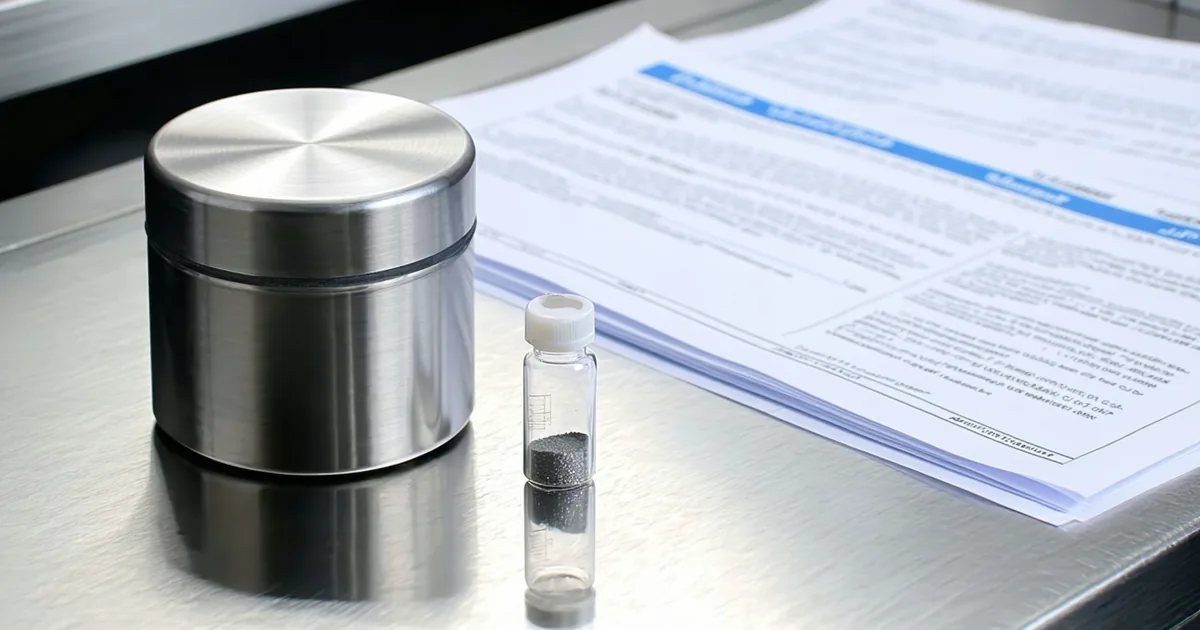
Our incoming inspection for Ti-6Al-4V ELI powder covers three items:
- Visual and packaging inspection. The sealed container is inspected for physical integrity before opening. Any breach — damaged seal, moisture ingress indicator triggered, discoloration of the desiccant — triggers a lot rejection without opening.
- Particle size verification. A representative sample is analyzed by laser diffraction. We verify that D10, D50, and D90 are within the acceptable range for our build parameters (typically D50 of 30–45 µm for our layer thickness of 30 µm) and consistent with the vendor's reported values. A significant deviation in D90 — indicating oversized particles — is cause for rejection; oversized particles in a powder bed cause layer spreading defects.
- Flowability check. Hall flow rate per ASTM B213. Poor flowability (high flow rate indicating irregular particle morphology or satellite contamination) correlates with uneven powder deposition and density variation in the build.
The results of incoming inspection are archived to the powder lot ID. The lot is not released to the build floor until incoming inspection passes and the acceptance record is closed.
Node 3: Powder storage and handling
Ti-6Al-4V is highly susceptible to oxygen pickup at elevated temperature, but even at room temperature, prolonged exposure to ambient humidity can increase the oxygen content of fine powder particles at the surface through adsorption. Storage in sealed containers under dry nitrogen or argon backfill is the standard approach. Humidity in the storage area should be monitored and logged as part of the environmental controls.
More importantly: powder lots must be clearly labeled and physically segregated. A lot mix-up — loading the wrong powder into a build — is not detectable by visual inspection of the finished part. It is only detected by tracing the powder lot record back to the incoming inspection data. This means the label on the container must be treated as a quality record, not a convenience label, and any container that has lost its label must be quarantined and re-verified before use.
Node 4: Linking powder lot to the build record
When a build is initiated, the powder lot ID loaded into the machine is recorded in the build traveler before the build begins. This is not done after the fact — it is done as part of the build setup checklist, which is a controlled document with sign-off required before machine start.
The build job number is then assigned and cross-referenced to the powder lot ID in the build record. Every part serial number assigned to parts in that build inherits the powder lot linkage. When the documentation package is assembled for delivery, the part serial number → build job number → powder lot ID → vendor CoC chain is complete and auditable in both directions: you can go from the part serial number to the vendor CoC, or from the vendor CoC to every part serial number that used that lot.
This bidirectional traceability is important for the case where a lot-level problem is discovered after parts have been delivered. If a vendor issues a correction to a previously certified lot (which does happen), you need to be able to identify every part made from that lot, regardless of when they were delivered or to whom. Without bidirectional traceability, a lot-level correction event is a containment problem with no boundary.
Node 5: Recycled powder management
LPBF processes consume only a fraction of the loaded powder during any given build. The remainder — the unfused powder surrounding the parts — can be sieved and reused. Managing recycled powder is one of the more complex aspects of traceability in LPBF operations.
The principal concern with recycled Ti-6Al-4V powder is oxygen pickup. Each thermal cycle in the machine slightly increases the oxygen content of the powder particles exposed to the melt pool boundary and the heated atmosphere (even under argon). Repeated recycling without blending with fresh powder eventually produces a lot with elevated oxygen content, which shifts the mechanical properties of the printed material — specifically, reducing ductility and toughness while slightly increasing strength and hardness.
Industry practice for aerospace applications typically limits the number of recycle cycles, requires oxygen content verification before reuse, and maintains lot-level records of cycle count and blend ratios with fresh powder. Our recycled powder management procedure assigns a cycle count to each powder lot and requires re-verification of oxygen content (by carrier gas fusion, ASTM E1019) before a recycled lot is approved for another flight-hardware build. The cycle count and blend records are part of the powder lot record and are included in the documentation package delivered to the customer.
What a complete documentation package looks like
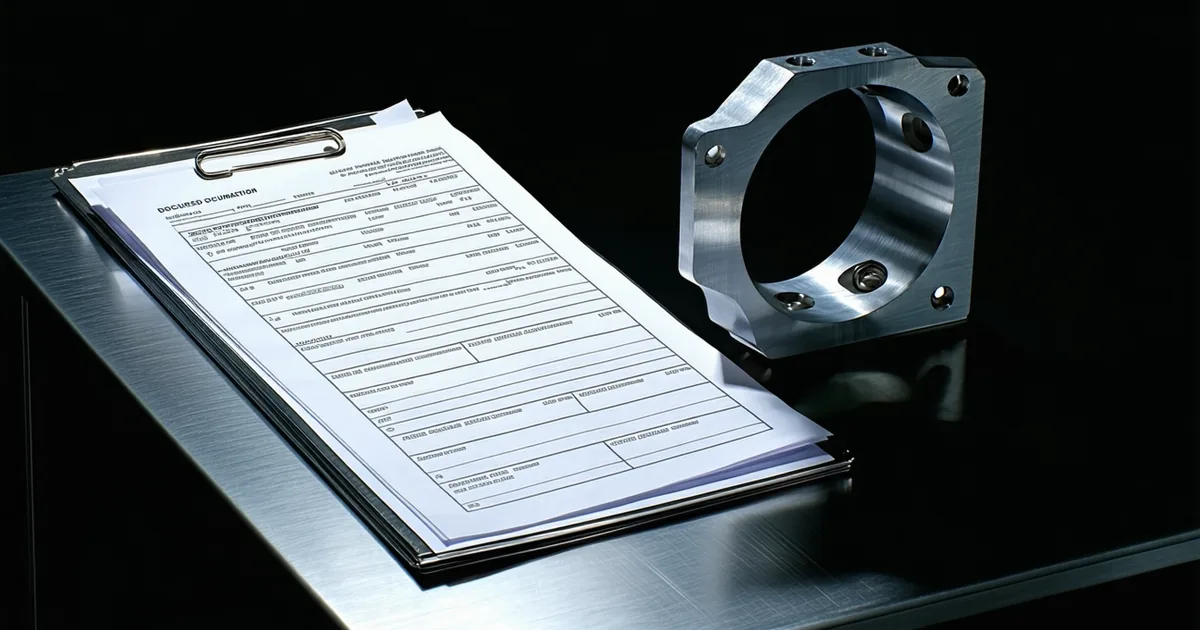
When a flight-hardware part ships from Additiveio, the documentation package includes the following powder-related records:
- Vendor certificate of conformance (chemistry, PSD, flowability) for the specific lot used
- Incoming inspection record with our facility's spot-check data and acceptance sign-off
- Powder lot storage and handling log (storage conditions, date of receipt, date of build use)
- Build traveler showing powder lot ID loaded at build initiation, with operator sign-off
- Recycled powder cycle count and blend record, if applicable
Together, these records constitute a chain of custody that an aerospace quality engineer can trace from the finished part back to the original vendor lot without any gap. That chain is what "powder traceability" actually means in practice — not just a CoC attached to a shipment, but a closed loop of records linking material identity to manufacturing event to delivered part.
Why traceability gaps matter more in AM than in machining
In a machined part made from billet stock, the starting material is a solid form with a mill cert tied to a heat number stamped on the billet. If the billet is kept intact through rough and finish machining, the traceability chain is relatively straightforward. The material's identity doesn't change between receipt and delivery.
In a powder-bed-fusion process, the starting material is a bulk commodity that is loaded, partially consumed, partially recycled, and partially blended. The identity of the specific powder grains that melted to form a given feature of the part cannot be recovered after the fact — only the lot-level record can. This means the traceability record must be established in real time, at the build setup step, or it cannot be established at all. You cannot go back and reconstruct which powder lot was in the machine on a given date if the build traveler wasn't completed at the time.
This is why incoming inspection and build traveler discipline are not optional administrative overhead in aerospace AM. They are the only mechanism by which material traceability can exist at all. A shop that defers documentation to after delivery has already lost the chain — they just haven't been asked to prove it yet.